
Analysis: Why Sequoia Capital US Lists Communication Protocols as One of Five Major Investment Themes
Recently, several media outlets have been sharing an article titled "The $10 Trillion AI Revolution: Why It's More Impactful Than the Industrial Revolution".
The article mentions five future investment themes, one of which is seamless communication protocols. However, the article doesn't elaborate on this conclusion in detail. We have been researching agent protocols for a very long time and have developed the open-source Agent Network Protocol (ANP), while also exploring commercial products for agent connectivity infrastructure. We strongly agree with Sequoia's viewpoint, as we were already proposing such visions and concepts at the end of last year. Today, from our perspective, we will provide an in-depth analysis of Sequoia's viewpoint.
Let's start with the conclusion: Protocols themselves are very difficult to commercialize directly, especially internet protocols. As we can see, whether it's MCP, A2A, or ANP, they are all completely free, and there won't be community versions versus commercial versions. We should thank Tim Berners-Lee, the inventor of the World Wide Web and author of HTTP, for this - HTTP is also completely free. Therefore, while protocols have high value and importance, they don't have direct investment value.
When Sequoia says communication protocols are a key future investment theme, what are they investing in? Specifically, they're investing in protocol-related infrastructure. From an abstract and long-term perspective, they're investing in the paradigm shift in internet connectivity brought about by protocols. Currently, people's main focus is still on AI's improvement of production efficiency. AI's impact on connectivity and changes to internet production relationships has not yet become a focus. However, I've always believed that the greatest value startups can capture lies not in production efficiency, but in the transformation of production relationships.
Why are protocols important for agents? Let's first ask a deeper question: why did internet businesses rarely use protocols for direct connection during the mobile internet and PC internet eras (email being one exception)? Because first, there was no demand, and second, the technology wasn't mature.
2.1 Where does the demand for agent protocols come from? The answer is context. For agents or AI to obtain complete context, standardized protocols are the most efficient approach. Protocols are also the most efficient containers for context transmission. Standardized protocols can break platform boundaries and data silos, allowing AI to obtain complete context while reducing connection costs to form new ecosystems.
2.2 Why is the technology for agents using protocols now mature? Protocol formulation, integration, and joint debugging are extremely costly endeavors. In traditional internet, having two platforms from different companies use protocols for complex business interactions (like e-commerce scenarios) was simply unimaginable. So we can see that protocols were generally used in simple business scenarios, such as email and phone calls. AI has changed all of this. MCP/A2A/ANP are all AI-driven protocols: AI understands protocol specifications and triggers protocol requests, making their design and operation different from others.
2.3 The above two points are extremely important and represent the first principles of why protocols can become important infrastructure for agents or the agent internet.
- What kind of connectivity paradigm shift can protocols bring to the internet? Simply put, it's a shift from platform-centric closed connections to protocol-centric open connections. Sequoia provided an e-commerce use case that is very typical - this new connectivity paradigm will significantly impact e-commerce, especially existing e-commerce platforms.
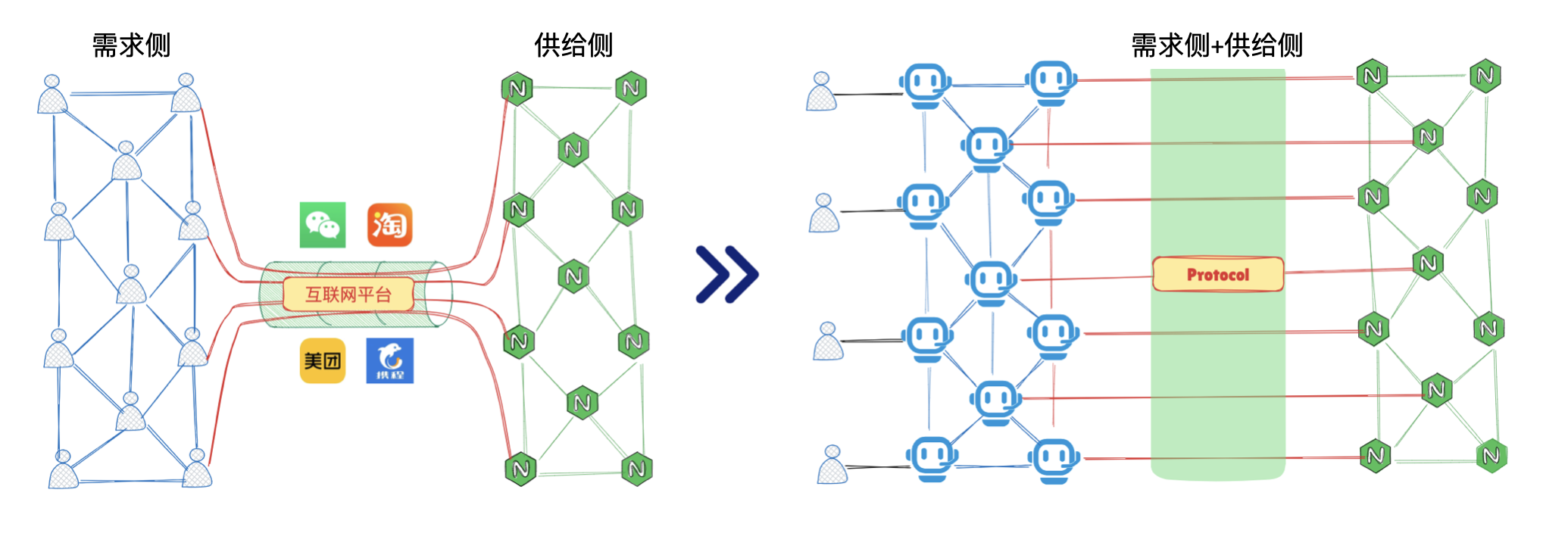
The new connectivity paradigm will restructure internet traffic patterns. Traffic will flow from super apps or internet platforms to AI applications represented by personal assistants, with ChatGPT's over 700 million weekly active users being a typical example. Personal assistants can use protocols to directly connect to supply-side agents, such as personal assistants directly connecting to hotel agents to book hotels. Direct connection between demand-side and supply-side without going through internet platforms is the most important characteristic of the new connectivity paradigm.
Why use protocols? We analyzed this from a technical perspective above. Why do demand and supply need to connect directly? The fundamental reason is that direct connection can reduce transaction links and lower transaction costs. The greatest value of e-commerce platforms is reducing intermediary links, and AI will further reduce transaction intermediaries, allowing buyers and sellers to trade directly, thereby lowering transaction costs. Teacher Hou Hong has provided even deeper analysis on this issue (On the Rise of the Agent Internet).
Changes in traffic structure will further restructure the internet's value chain. Existing internet companies may not be able to capture the corresponding value of the future internet. For example, personal assistants will become new heavyweight participants, serving as the new generation gateway and participating in new value distribution. AI phone companies are all focusing on personal assistants, and large model companies like DeepSeek, Kimi, including ChatGPT, can't think of better commercialization paths other than personal assistants. New ecosystem companies formed around personal assistants will also participate in new value distribution.
The ultimate result is that the future internet structure will undergo earth-shaking changes compared to the current internet structure. This contains many opportunities for startups and many opportunities for investors.
So in my view, when Sequoia Capital US says they're investing in communication protocols, they're actually saying they want to invest in the enormous opportunities brought by "structural changes to the internet triggered by protocols." The e-commerce example Sequoia mentioned later is a specific demonstration of this opportunity.
Will this trend (new connectivity paradigm) definitely happen? There are many factors, but I believe the two most core ones are: First, whether connection efficiency is higher and transaction costs are lower - reducing transaction links is the most direct approach. Second, whether the experience is better - agents using protocols for open connections will definitely be better than closed ecosystems in terms of context engineering construction. The more complete the context, the better the agent experience will be.
The roles currently undertaken by platforms, such as digitization, search and recommendation, trust verification, and after-sales service, will be met by new infrastructure. But they differ from existing platforms - they're more like tools.
Regarding competition: Building closed agent ecosystems based on existing ecosystems is basically what internet giants will inevitably do next, and giants will compete fiercely with each other. But there will also be major competition between open ecosystems and closed ecosystems in the future. New agent forces (AI phones, large model companies, agent startups) prefer open agent ecosystems, as there aren't many opportunities in closed ecosystems.
Finally, if you want to explore investment opportunities in this direction, feel free to chat with us. We've been exploring this direction very early and should be at the forefront of the industry in terms of understanding and exploration.
If you're interested in open-source agent communication protocols, you're also welcome to follow our open-source community. Or you can make donations to our community - recently, companies have clearly expressed donation intentions, and we're also promoting ANP's entry into an open-source foundation, which would make accepting donations more compliant.
You can contact me : chgaowei@gmail.com