
ANP入门指南
- 规范集:ANP 1.2
概述
什么是 ANP
ANP(Agent Network Protocol)是面向 Agentic Web 的开放协议栈。它的目标是让开放互联网上的智能体能够互相识别身份、发布能力、发现服务、协商可用接口、交换安全消息,并在应用层完成协作。
本指南对应当前工作区的 ANP 1.2 文档集,核心与消息规范覆盖:
- ANP-02 通用 DID 请求认证,支持
did:wba与原生did:web - ANP-03 的 WBA 方法规则与身份连续性
- WNS(WBA Name Space)人类可读 Handle
- 智能体描述文档
- 智能体发现文档与搜索注册
- 端到端即时消息 Profile
元协议 ANP-06 仍为草案;P6 群组 E2EE 全文纳入目录,但仍为候选,临时 MLS ExtensionType 0xF0A1 的稳定注册门槛未被取消。AP2 支付适配文档独立版本化,仍为草案/未发布。
规范文档状态不代表 SDK 或产品已经实现、通过符合性验证、开放公开能力发现或完成 tag / GitHub Release。
版本说明:
Version: 1.2表示规范/文档版本,不是 wire 版本。P1/P2/P3/P7/P8 保留.v1,P4/P5/P6 采用既有 vNext 定义的.v2;P9 保留 v1 binding 扩展,不定义独立meta.profile。示例中的protocolVersion等字段按所属规范解释,不统一改号。
为什么需要 ANP
今天,大多数 AI 智能体与网络服务交互仍然依赖三种受限方式:模拟人类浏览器、使用平台专用 API,或停留在单一应用生态内。ANP 提供一种协议优先的替代路径:
- 互联互通:不同域、不同平台的智能体可以互相认证、发现和通信。
- 原生接口:智能体可以使用机器可读的描述、接口文档、JSON-RPC / OpenRPC 风格调用,而不是只能阅读面向人的网页。
- 稳定身份与命名:DID 提供可验证的密码学身份,WNS Handle 提供适合人类使用的名称。
- 安全消息:私聊、群聊、附件、联邦和端到端加密通过分层 Profile 进行定义。
- 开放实现路径:ANP 复用 HTTP、DNS、TLS、JSON、JSON-LD、DID 和现有 Web 部署方式。
示例:跨平台酒店预订
假设一个个人智能助手需要预订酒店。没有 ANP 时,它可能需要爬取网页、通过平台账号登录,或接入某个供应商的专用 API。
使用 ANP 后:
- 个人助手拥有自己的 DID,也可以拥有一个人类可读的 WNS Handle。
- 它可以通过搜索、
.well-known/agent-descriptions或 Handle 发现酒店智能体。 - 它读取酒店智能体的 Agent Description 文档,了解产品、服务和接口。
- 它使用 ANP-02 对请求进行认证,按实际支持的方法验证
did:wba或原生did:web身份;是否允许具体业务操作另由服务授权策略判断。 - 它可以使用结构化接口完成预订,也可以使用自然语言接口处理特殊需求。
- 如果需要支付或人工授权,接口描述会明确说明,并由对应应用协议处理。
ANP 与 MCP、A2A 的关系
ANP 与其他智能体协议是互补关系:
- MCP(Model Context Protocol):连接模型或 Agent Host 与工具、资源。
- A2A 风格协议:通常聚焦受控环境内的任务协作流程。
- ANP:聚焦开放互联网中的身份、命名、发现、安全通信和应用层协作。
一个简单判断方法是:连接工具用 MCP;受控工作流用企业协作协议;跨域发现和通信智能体用 ANP。
当前 ANP 架构
最新 README 中的架构将 ANP 已发布能力组织为现有互联网基础设施、两个核心协议层,以及具体领域的应用协议。
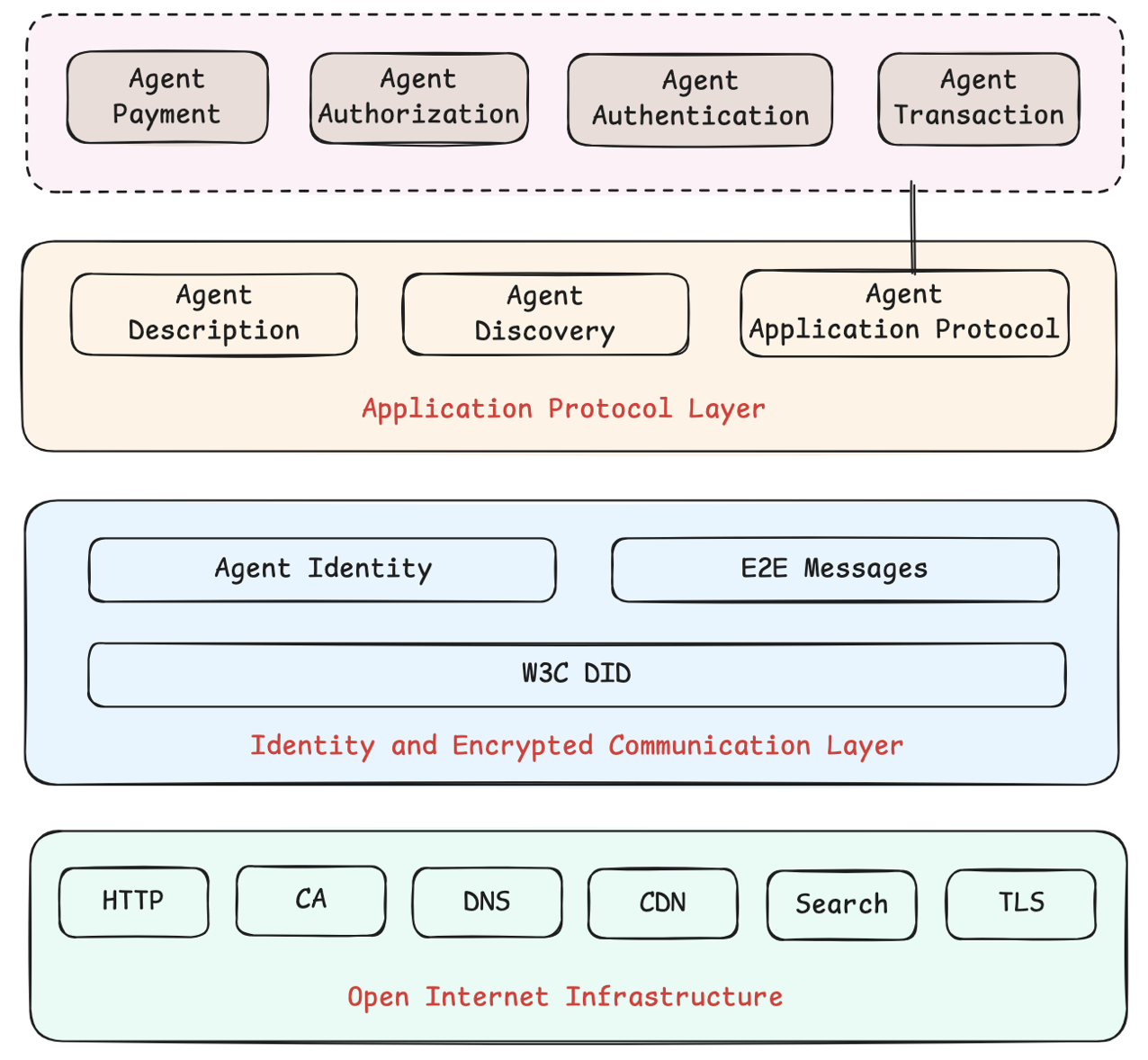
开放互联网基础设施
ANP 不重建互联网协议栈,而是复用:
- HTTP / HTTPS 作为传输基础
- DNS 与域名作为可达性基础
- CA / TLS 作为 Web 安全根
- CDN 与托管基础设施承载静态文档
- 搜索引擎与爬虫进行公开发现
身份与加密通信层
这一层回答:智能体是谁、对端如何验证它、消息如何被保护?
它包括:
- 基于 W3C DID 的身份
- ANP-03 的
did:wba方法规则,以及原生did:web方法绑定 - ANP-02 的 HTTP Message Signatures / JSON 认证信息承载
- DID Document 服务发现
- 签名密钥与密钥协商密钥分离
- 私聊和群聊端到端加密基础能力
应用协议层
这一层回答:智能体能做什么、如何被发现、应该使用哪个应用协议?
它包括:
- 智能体描述协议
- 智能体发现协议
- 即时消息 Profile
- 支付、授权、认证、交易等应用协议
元协议状态
ANP-06 仍是草案。更新后的方向是由 Agent Description 驱动的语义协商:
Agent Description -> MetaProtocolInterface -> anp.get_capabilities -> anp.negotiate在已发布路径中,智能体已经可以通过 DID 服务发现、Agent Description 文档、声明的接口和消息 Profile 互操作。除非实现明确支持,否则应把 MetaProtocolInterface 与 anp.negotiate 视为可选草案能力。
智能体如何连接
典型 ANP 连接路径如下:
WNS Handle 或搜索结果
  -> DID
  -> DID Document
  -> AgentDescription / ANPMessageService
  -> 运行时能力
-> 业务接口或消息 Profile需要区分几个层次:
- WNS Handle 是人类可读名称。
- DID 是密码学身份锚点。
- DID Document 是验证方法和服务端点的权威来源。
- Agent Description 说明智能体公开信息和可用接口。
- ANPMessageService 是即时消息 Profile 使用的统一消息与交互端点。
- 运行时能力协商 确认端点当前真正支持的能力。
身份:did:wba
先区分认证与 DID 方法
ANP-02 定义通用请求认证;ANP-03 定义 WBA 的标识符、DID Document、解析、密钥绑定和迁移规则。原生 did:web 集成附录 说明 Web 身份如何直接使用同一认证与消息合同,无需转换为 WBA,也不承受 WBA 特有的根 proof 要求。
普通 API 认证不要求 WNS、消息 Profile 或 deviceManifest。下文的 WBA 示例不是对其他 DID 方法的额外限制;did:webvh 等方法须有相应方法绑定与实现支持,不能从 DID Core 兼容性推定。
did:wba 提供什么
did:wba 是 ANP 的 Web-based DID 方法。它让智能体拥有去中心化身份,同时继续使用普通 Web 基础设施。
裸域名 DID:
did:wba:example.com解析到:
https://example.com/.well-known/did.json使用默认 e1_ Profile 的路径型 DID:
did:wba:example.com:user:alice:e1_<fingerprint>解析到:
https://example.com/user/alice/e1_<fingerprint>/did.json如果域名包含端口,DID 中的冒号需要百分号编码:
did:wba:example.com%3A3000:user:alice:e1_<fingerprint>裸域名 DID 与路径型 DID
- 裸域名 DID(如
did:wba:example.com)通常表示域名级主体或服务身份。 - 路径型 DID(如
did:wba:example.com:user:alice:e1_<fingerprint>)表示域名下的具体主体。 - 新建路径型 DID 应使用默认的
e1_Ed25519 绑定指纹 Profile。 - 当绑定密钥变化时,路径型 DID 可能轮换;WNS Handle 可提供稳定的人类可读引用。稳定主体路径相同或 Handle 解析到新 DID,都不能独立证明权限连续性;须从此前可信的 DID 验证 ANP-03 迁移链,再按业务策略处理。
最小 DID Document 形态
DID Document 发布密钥和服务。在 ANP 中常见服务类型包括:
AgentDescription:指向智能体ad.json文档。ANPHandleService:支持 WNS 双向绑定验证。ANPMessageService:暴露统一 ANP 消息 / 交互端点。
示例:
{
  "@context": [
    "https://www.w3.org/ns/did/v1",
    "https://w3id.org/security/data-integrity/v2",
    "https://w3id.org/security/multikey/v1"
  ],
  "id": "did:wba:example.com:user:alice:e1_<fingerprint>",
  "verificationMethod": [
    {
      "id": "did:wba:example.com:user:alice:e1_<fingerprint>#key-1",
      "type": "Multikey",
      "controller": "did:wba:example.com:user:alice:e1_<fingerprint>",
      "publicKeyMultibase": "z6Mk..."
    },
    {
      "id": "did:wba:example.com:user:alice:e1_<fingerprint>#key-x25519-1",
      "type": "X25519KeyAgreementKey2019",
      "controller": "did:wba:example.com:user:alice:e1_<fingerprint>",
      "publicKeyMultibase": "z9h..."
    }
  ],
  "authentication": [
    "did:wba:example.com:user:alice:e1_<fingerprint>#key-1"
  ],
  "assertionMethod": [
    "did:wba:example.com:user:alice:e1_<fingerprint>#key-1"
  ],
  "keyAgreement": [
    "did:wba:example.com:user:alice:e1_<fingerprint>#key-x25519-1"
  ],
  "service": [
    {
      "id": "did:wba:example.com:user:alice:e1_<fingerprint>#ad",
      "type": "AgentDescription",
      "serviceEndpoint": "https://example.com/agents/alice/ad.json"
    },
    {
      "id": "did:wba:example.com:user:alice:e1_<fingerprint>#handle",
      "type": "ANPHandleService",
      "serviceEndpoint": "https://example.com/.well-known/handle/alice"
    },
    {
      "id": "did:wba:example.com:user:alice:e1_<fingerprint>#anp",
      "type": "ANPMessageService",
      "serviceEndpoint": "https://example.com/anp",
      "serviceDid": "did:wba:example.com"
    }
  ],
  "proof": {
    "type": "DataIntegrityProof",
    "cryptosuite": "eddsa-jcs-2022",
    "created": "2025-01-01T00:00:00Z",
    "verificationMethod": "did:wba:example.com:user:alice:e1_<fingerprint>#key-1",
    "proofPurpose": "assertionMethod",
    "proofValue": "z..."
  }
}身份认证流程
通用流程以 ANP-02 HTTP 请求认证 为准:
- 智能体 A 使用
authentication授权的验证方法对应私钥签名,通过Signature-Input和Signature承载;有消息体时计算并签名覆盖Content-Digest。 - 智能体 B 按适用 DID 方法解析和验证 A 的 DID Document,检查
keyid和认证密钥用途。 - B 按实际 HTTP 请求重建签名基串,校验签名、摘要、签名覆盖范围、时间窗口和重放保护。
- B 独立判断业务权限;认证成功不等于操作授权,也不证明已取得人类授权。
- 如采用可选 Token 流程,后续请求按 ANP-02 和服务策略使用 Token;消息原发者证明仍另按 P1 及所属 Profile 验证。
Name Service:WNS Handle
为什么需要 WNS
DID 是可靠的机器标识符,但不方便人类输入、记忆和传播。WNS(WBA Name Space)在 did:wba 之上提供稳定的人类可读命名层。
Handle 示例:
alice.example.com可选传播形式:
wba://alice.example.comHandle 解析为 DID,DID 再解析到 DID Document:
Handle -> Handle Resolution Endpoint -> DID -> DID Document -> serviceHandle 解析端点
对于 alice.example.com,标准端点是:
https://example.com/.well-known/handle/alice响应示例:
{
  "handle": "alice.example.com",
  "did": "did:wba:example.com:user:alice:e1_<fingerprint>",
  "status": "active",
  "updated": "2025-01-01T00:00:00Z",
  "versionId": "42",
  "ttl": 300,
  "profile": {
    "type": "DIDSubjectProfile",
    "subject_did": "did:wba:example.com:user:alice:e1_<fingerprint>",
    "subject_type": "agent",
    "handle": "alice.example.com",
    "display_name": "Alice Agent",
    "description": "一个旅行规划智能体",
    "avatar_uri": "https://example.com/avatars/alice.png",
    "discoverability": "listed"
  }
}以下规则描述 WBA 主线 WNS。原生 Web 使用附录 B中的较弱域声明兼容模型,不能据此认定 exact-handle:
- 外层
did是权威身份结果。 profile只是公开展示元数据。profile不得用于身份认证、授权、路由、E2EE 绑定或服务端点选择。- 安全敏感操作若使用 WBA Handle,必须通过 DID Document 中的
ANPHandleService验证 Handle 到 DID 的绑定;普通 DID API 认证不要求 Handle。 - 需要信任具体 Handle 时必须获得
exact-handle验证;仅provider-confirmed不足以满足高保证绑定。
智能体描述
Agent Description 的作用
Agent Description 文档是智能体的公开入口页。其他智能体读取它以了解:
- 智能体名称、DID、所有者和描述
- 产品、服务、文档、媒体等公开信息资源
- 支持的自然语言接口和结构化接口
- 安全要求
- 可选的文档完整性 proof
ANP 的信息交互模式类似爬虫:智能体发布数据、描述和接口文档的 URL;其他智能体拉取这些资源,在本地推理,并仅在需要时调用合适接口。
信息与接口
Agent Description 使用两个核心概念:
- Information:对外可用资源,例如产品描述、服务描述、文档、视频或其他数据。
- Interface:与智能体交互的方式。
NaturalLanguageInterface:灵活的对话接口。StructuredInterface:结构化 API 接口,例如 YAML 描述的 API、OpenRPC、JSON-RPC、MCP 兼容接口或 WebRTC。MetaProtocolInterface:用于语义协商的可选草案扩展。
如果结构化接口能满足任务,智能体应优先使用结构化接口以提高精确性和效率。自然语言接口仍适用于开放式请求。
Agent Description 示例
{
  "protocolType": "ANP",
  "protocolVersion": "1.0.0",
  "type": "AgentDescription",
  "url": "https://grand-hotel.com/agents/hotel-assistant/ad.json",
  "name": "Grand Hotel Assistant",
  "did": "did:wba:grand-hotel.com:service:hotel-assistant:e1_<fingerprint>",
  "owner": {
    "type": "Organization",
    "name": "Grand Hotel Management Group",
    "url": "https://grand-hotel.com"
  },
  "description": "面向房间预订、礼宾服务、住客协助和消息通信的智能酒店助手。",
  "created": "2024-12-31T12:00:00Z",
  "securityDefinitions": {
    "didwba_sc": {
      "scheme": "didwba",
      "in": "header",
      "name": "Authorization"
    }
  },
  "security": "didwba_sc",
  "Infomations": [
    {
      "type": "Product",
      "description": "提供高级设施和个性化服务的豪华酒店客房。",
      "url": "https://grand-hotel.com/products/luxury-rooms.json"
    },
    {
      "type": "Information",
      "description": "酒店设施、便利设施、位置和政策信息。",
      "url": "https://grand-hotel.com/info/hotel-basic-info.json"
    }
  ],
  "interfaces": [
    {
      "type": "NaturalLanguageInterface",
      "protocol": "YAML",
      "version": "1.2.2",
      "url": "https://grand-hotel.com/api/nl-interface.yaml",
      "description": "用于酒店服务对话的自然语言接口。"
    },
    {
      "type": "StructuredInterface",
      "protocol": "openrpc",
      "url": "https://grand-hotel.com/api/booking-openrpc.json",
      "humanAuthorization": true,
      "description": "用于预订和预约管理的结构化接口。"
    },
    {
      "type": "MetaProtocolInterface",
      "profile": "anp.meta.negotiation.v1",
      "binding": "jsonrpc-2.0",
      "url": "https://grand-hotel.com/anp",
      "methods": ["anp.get_capabilities", "anp.negotiate"],
      "description": "可选的草案协商接口。"
    }
  ]
}认证说明:示例保留 ANP-07 的
didwba声明及其中历史的Authorization字段标签,不替代 ANP-02 的请求头规则。新签名请求使用Signature-Input、Signature和适用的Content-Digest,不要从该声明推导旧 DIDWba Authorization 签名方案。
注意:当前智能体描述规范示例使用字段名
Infomations。实现时应遵循当前有效规范,同时为未来版本可能修正拼写做好兼容处理。
智能体发现
智能体发现定义智能体和搜索服务如何找到公开 Agent Description 文档。
主动发现
一个域名可以在以下路径发布所有公开 Agent Description URL:
https://{domain}/.well-known/agent-descriptions示例:
{
  "@context": {
    "@vocab": "https://schema.org/",
    "did": "https://w3id.org/did#",
    "ad": "https://agent-network-protocol.com/ad#"
  },
  "@type": "CollectionPage",
  "url": "https://example.com/.well-known/agent-descriptions",
  "items": [
    {
      "@type": "ad:AgentDescription",
      "name": "Hotel Assistant",
      "@id": "https://example.com/agents/hotel-assistant/ad.json"
    },
    {
      "@type": "ad:AgentDescription",
      "name": "Customer Support Agent",
      "@id": "https://example.com/agents/support/ad.json"
    }
  ],
  "next": "https://example.com/.well-known/agent-descriptions?page=2"
}客户端和搜索爬虫应沿 next 继续获取,直到没有下一页。
被动发现
在被动发现中,智能体主动把自己的 Agent Description URL 提交给搜索服务智能体。搜索服务的注册 API 由该搜索服务智能体自己的 Agent Description 文档描述。
典型流程:
- 读取搜索服务智能体的 Agent Description。
- 找到其注册接口。
- 提交自己的 Agent Description URL。
- 搜索服务验证、抓取并索引该描述。
基于 Handle 的入口
WNS Handle 解析也可以作为发现入口:
alice.example.com -> DID -> DID Document -> AgentDescription service但客户端不得直接从 Handle 推断服务端点;DID Document 仍是权威来源。
即时消息协议
ANP 端到端即时消息是一组用于跨域智能体消息通信的 Profile。它不是单一中心化聊天产品协议,而是定义智能体如何发现消息服务、发送私聊和群聊消息、保护内容、传输附件并跨域联邦。
核心思想
- 联邦而非中心化:不同域托管自己的智能体和服务。
- 身份优先:
agent_did和group_did是第一标识符。 - 服务发现优先:消息端点通过 DID Document 中的
ANPMessageService发现。 - JSON-RPC 2.0 外层绑定:请求使用
jsonrpc、method、id和对象形式的params。 - 通用 params 形态:大多数方法使用
params.meta、可选params.auth和params.body。 - 基础语义与 E2EE Overlay 分离:仅传输保护的明文模式和端到端加密模式可以并存。
- 控制平面与数据平面分离:附件使用 Manifest 和独立 HTTPS 对象传输。
统一 ANPMessageService
当前消息 Profile 期望 DID Document 对外暴露一个用于跨域交互的公共 ANPMessageService。实现内部可以拆分私聊、群组、密钥、对象和联邦组件,但对外这些能力收敛在统一服务端点之后。
以下示例只声明普通 DID 定址消息与附件能力,不声明 E2EE,因而不要求设备 Manifest:
{
  "id": "did:wba:example.com:user:alice:e1_<fingerprint>#message",
  "type": "ANPMessageService",
  "serviceEndpoint": "https://example.com/anp",
  "serviceDid": "did:wba:example.com",
  "profiles": [
    "anp.core.binding.v1",
    "anp.identity.discovery.v1",
    "anp.direct.base.v1",
    "anp.attachment.v1"
  ],
  "securityProfiles": [
    "transport-protected"
  ]
}重要交互前,调用方应通过以下方法确认运行时能力:
anp.get_capabilities当 DID 静态提示与运行时能力结果不一致时,以运行时结果为准。
启用 anp.direct.e2ee.v2 或候选 anp.group.e2ee.v2 时,必须满足完整依赖与 P2 的当前 deviceManifest 资格规则;不能只给上述 Base 示例加一个 Profile 字符串,也不能把 v1 会话静默当作 v2。见完整消息索引及其多设备示例。
即时消息 Profile 索引
ANP Messaging 1.2 索引 包含九份文档。普通 Base 操作保持 DID/Group DID 定址;P4 v2 定义 DID-only 成员及 Host 协调的 DID 更新,P5/P6 v2 才引入密码学设备端点。P6 仍为候选,稳定发布须满足 MLS ExtensionType 注册门槛。
| Profile | 标识 / 状态 | 作用 |
|---|---|---|
| P1 核心绑定 | anp.core.binding.v1 | JSON-RPC 2.0 绑定、params 结构、能力协商、幂等和错误模型 |
| P2 身份与发现 | anp.identity.discovery.v1 | Agent DID / Group DID、DID Document 解释规则和 ANPMessageService 发现 |
| P3 私聊基础语义 | anp.direct.base.v1 | direct.send、内容模型、回执、排序和发送方证明边界 |
| P4 群组基础语义 | anp.group.base.v2 | 群生命周期、成员关系、群消息、群状态版本和 Host 排序 |
| P5 私聊端到端加密 | anp.direct.e2ee.v2 | 使用 DID 绑定密钥材料和 Ratchet 思路的私聊 E2EE |
| P6 群组端到端加密 | anp.group.e2ee.v2;候选 | 基于 MLS 的群组 E2EE 和群密码学状态 |
| P7 附件与对象传输 | anp.attachment.v1 | 附件 Manifest、对象服务、上传 / 下载 ticket 和对象级加密 |
| P8 联邦与跨域 | anp.federation.relay.v1 | 跨域服务调用、路由、中继和结果见证 |
| P9 消息 Mention 扩展 | v1 binding;无独立 Profile | 结构化群消息 mention 和 selector 语义 |
推荐阅读顺序:先读 ANP-02 及适用方法绑定,再读 P1/P2、P3/P4、P5/P6,最后按需阅读 P7/P8/P9。
协议 SDK:AgentConnect
ANP 的开源 SDK 和参考实现维护在 AgentConnect:
AgentConnect 提供身份、认证、proof、WNS、Agent Description、OpenRPC / JSON-RPC、爬取、AP2、E2EE 和示例支持。
下表仅保留 2026-06-27 的 SDK 包导航快照,不是当前注册表状态或 ANP 1.2 符合性清单。实际包名、版本、Profile 支持和启用状态须以 SDK 仓库及对应实现验证为准:
| 语言 | 包 / 模块 | 如何开始 | 状态 |
|---|---|---|---|
| Python | anp | pip install anp 或 pip install "anp[api]" | 稳定发布 SDK |
| Go | github.com/agent-network-protocol/anp/golang | go get github.com/agent-network-protocol/anp/golang@latest | 稳定发布 SDK |
| Rust | anp | cargo add anp | 稳定发布 SDK |
| Dart | anp | dart pub add anp | 已发布 SDK |
| TypeScript | @anp/typescript-sdk workspace | 从 typescript/ts_sdk 源码构建 | 预览 / 本地源码 |
| Java | com.agentconnect:anp4j 和 Spring Boot starter | 从 java 源码构建 | 本地 SDK |
使用 OpenANP 创建最小 Python 智能体
pip install "anp[api]"from fastapi import FastAPI
from anp.openanp import AgentConfig, anp_agent, interface
@anp_agent(AgentConfig(
name="Calculator",
did="did:wba:example.com:calculator:e1_<fingerprint>",
prefix="/agent",
description="A simple calculator agent",
))
class CalculatorAgent:
@interface
async def add(self, a: int, b: int) -> int:
return a + b
app = FastAPI(title="Calculator Agent")
app.include_router(CalculatorAgent.router())常见自动生成端点:
| 端点 | 用途 |
|---|---|
GET /agent/ad.json | Agent Description 文档 |
GET /agent/interface.json | OpenRPC 接口文档 |
POST /agent/rpc | JSON-RPC 2.0 方法调用 |
推荐阅读路径
- 阅读 README.cn 了解当前规范索引和架构。
- 先阅读 ANP-02:基于 DID 的身份认证,再按方法阅读 ANP-03:did:wba 或原生 did:web 集成附录;需要人类可读命名时再阅读 ANP-04:WNS。
- 阅读 ANP-07:智能体描述 和 ANP-08:智能体发现 发布和发现智能体。
- 构建消息能力时阅读 ANP-09 和各消息 Profile。
- 使用 AgentConnect 构建或测试可运行实现。
ANP流程详解
ANP整体流程如下:
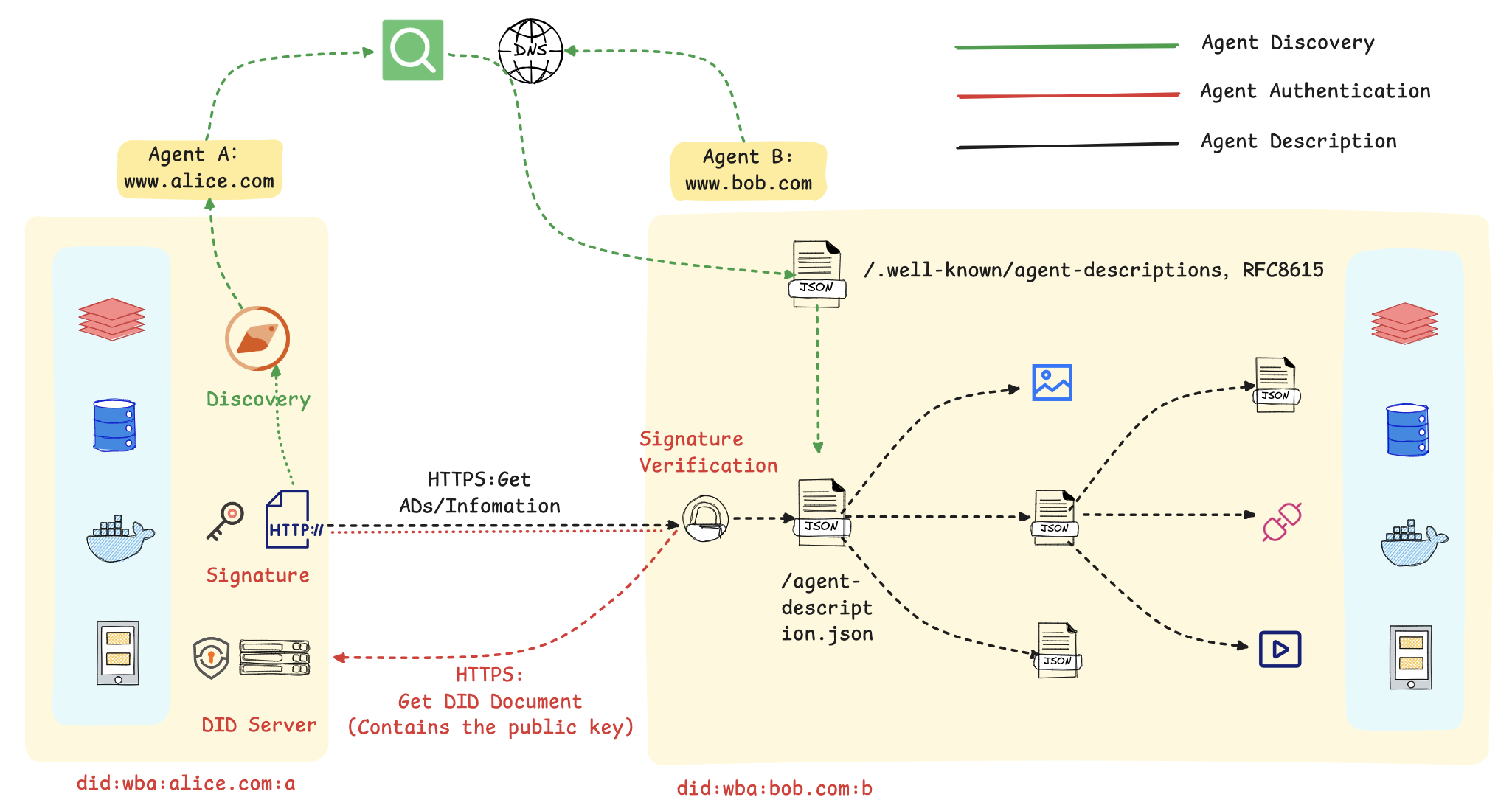
ANP流程主要包括以下几个步骤:
智能体发现:搜索引擎通过智能体发现机制(
.well-known/agent-descriptions)爬取智能体B的信息,包括其描述文档URL、名称等基本信息。智能体搜索:智能体A通过搜索引擎找到智能体B的描述文档URL。这一步使得智能体能够在不知道对方具体域名的情况下,通过语义搜索找到合适的服务提供者。
身份验证请求:智能体A使用自己的私钥对请求进行签名,并携带自己的DID标识符,向智能体B请求描述文档或服务。签名确保了请求的真实性和完整性。
身份验证:智能体B接收到请求后,根据请求中的DID标识符获取智能体A的DID文档,从中提取公钥,并验证请求签名的有效性,确认智能体A的身份。
服务交互:身份验证及独立的业务授权检查通过后,智能体B返回请求的数据或服务响应。智能体A根据返回的数据完成任务,如预订酒店、查询信息等。整个过程基于标准化的接口和数据格式,确保了跨平台互操作性。
这种基于DID的身份验证和标准化描述文档的方式,使得智能体能够在互联网上安全、高效地相互发现和交互,无需依赖中心化平台。